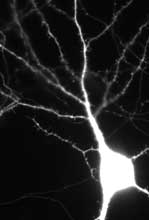
My lab is applying novel chemical biology tools and emerging biophysical techniques to solve fundemental questions in neuroscience. We will focus on three main topics that include:
1) receptor trafficking and ligand-gating
2) remote control of neuronal activity with chemicals and light
3) computer modeling of ligand recognition by biological receptors.
Focus 1 - Real-Time Protein Tracking
One of the main problems confronting neuroscience is a lack of understanding of the daily lives of membrane receptors. To study protein localization and dynamics, it is common to label a protein with a fluorescent tag or other contrast agent and track their motion with optical microscopy. The main strategies used for labeling are overexpression of a fusion protein and antibody-based labeling. These two methods, however, may lead to confounds based on disruption of native subunit composition or alteration of the activity of the target, respectively. Our receptor tagging method utilizes low molecular weight nanoprobes that can be remotely deployed to target specific receptors. The initial target for this project will be the subtype of the glutamate receptor called the AMPA receptor. The AMPA receptor is the main excitatory ion-channel involved in chemical synaptic transmission. Regulated trafficking of AMPA receptors into and out of the postsynaptic membrane has emerged as a central locus underlying many forms of synaptic plasticity. Synaptic plasticity underpins current theories on molecular mechanisms of learning and memory.
Focus 2 - Using Light and Chemistry to Affect Cellular Function
Various strategies have been devised for imparting light-sensitivity onto normally light-insensitive cells to remotely control their excitability. Coupling specifically substituted photochromic molecules with endogenous proteins has been successfully used to affect the activity of living cells. Light can be used to reversibly isomerize the attached photochromic molecule causing activation or inactivation of single cells or at specific locations on a cell, such as dendritic branches or even individual spines. In addition to using this current method, we will expand the toolbox for cell control using light. One idea is to develop a photoactivatable electrophilic group. Another idea is to alter the sensitivity for isomerization of the photoswitch to more desirable wavelengths for penetrating cellular tissue, for example infrared. One of the main limitations of using available photoswitches in vivo is poor penetration of UV and visible light into samples and thus poor efficacy of photoisomerization. Further, producing photoswitches with higher 2-photon absorption cross sections will allow both deep penetration and a very small photoswtiching volume (<< 1 um3) due to the focal properties of 2-photon excitation. These tools will be used to study activation (or silencing) of single branches and spines to measure the effect of blockade or chronic activation of AMPA receptors on synaptic plasticity. Novel chemical tools that allow control of neuronal function using only chemicals and light will be a research area of tremendous wealth in the next decade.
Focus 3 - Exploration of Small Molecule Binding Sites
The family of G-Protein-coupled receptors represents a large target for disease treatment as well as for a basic understanding of neuroscience. By using computational chemistry methods we plan to investigate further both the ligand binding sites and, more interestingly, activation mechanisms of members of the amine-binding GPCR family. We also have an interest in using this model in conjunction with library virtual screening to de-orphan orphan receptors. This vein of research will likely open up new areas of questioning for students in my lab who are interested in classical drug design and medicinal chemistry. Novel compounds will be synthesized to test hypotheses that are generated in silico. In addition to G-Protein-coupled receptors, we also plan to look closer at binding and gating events that underlie channel-opening in ligand-gated ion channels. Of particular interest to me are drug-like molecules that effect purine-gated ion channels for pain treatment and AMPA receptors to investigate the mechanism of AMPAkines, AMPA receptor modulators.
|